
How Many Home Batteries Do I Need?
How Many Home Batteries Do I Need?
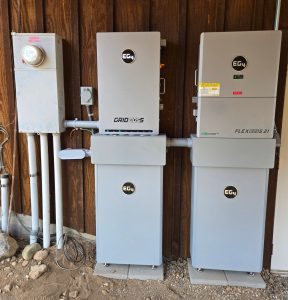
Kilowatts, kilowatt hours, and amps, oh my! Terms used to describe power use and energy storage for homes can be confusing and challenging to translate into practical requirements for your home.
Most homeowners have three basic questions about battery backup systems:
- How many batteries do you need?
- What will they power?
- How long will that power last?
Let’s break down these concepts into simpler terms to help you make informed decisions.
The Basics
The main goal when sizing a battery for your home is figuring out the storage capacity needed to meet your energy demands. This process considers factors such as what you want to power during an outage and for how long, and whether or not you have solar or a backup generator for recharging during a grid outage.
Selecting the right battery system for your home matters. The size of whatever backup system you choose impacts both how well it works and how much it costs. Picking a battery that’s too small might leave you without enough power during blackouts. On the other hand, if you get a battery that’s too big, you might spend more for equipment that takes up more space without any real benefit.
Relevant Terms
Here are some key terms you should know when discussing your batteries:
Kilowatt-hour (kWh): A unit of energy measurement, representing the amount of energy consumed or produced over one hour. It is used to quantify the energy storage capacity of home batteries.
Capacity: Refers to the total amount of energy that a home battery can store. It is typically expressed in kWh and is a crucial factor in determining how long the system can provide power without additional input.
Depth of Discharge (DoD): This metric indicates the percentage of a battery’s total capacity that can be safely utilized before recharging is required. For example, a battery with a 50% depth of discharge can only use half of its total capacity before needing to be recharged.
Calculating How Much Energy Storage You Need
To determine how many batteries your home needs, follow these steps:
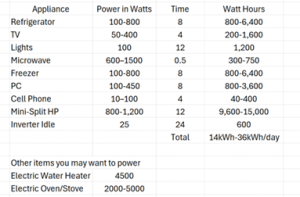 Begin by calculating your daily energy consumption in kilowatt-hours (kWh). Review your electricity bills or add up the energy consumption of individual appliances.
- Identify the essential appliances and systems you want to power during an outage, such as refrigerators, freezers, lighting, medical equipment, and heating or cooling systems. Estimate their combined energy usage in kWh.
While averages can be misleading, but for context, a typical U.S. household uses around 30kWh per day. If you only need to power basic essentials, a mid-sized 10–15kWh battery might be adequate. However, if you need to power your entire home, consider a system of 30kWh or greater.
- Consider how long you want the battery system to supply power during an outage when there’s no way to recharge it. If you live in an area prone to extended power outages, you may want a larger battery system that can provide power for several days without needing to be recharged.
- Once you have determined your average power consumption, essential loads, and desired backup duration, you can calculate your total load. Multiply your essential energy usage by the number of hours you want backup power.
- For example, if your essential loads require 2,000 watts of power and you want backup power for 24 hours, your total load would be 48,000 watt-hours (2,000 watts x 24 hours), or 48kWh of usable energy storage.
5. Check the capacity of modern lithium-ion or lithium ferro phosphate (also called LFP, or lithium iron phosphate) batteries, which typically range from 10 to 15kWh per unit.
6. Divide your total energy requirement by the capacity of a single battery to calculate the number of batteries needed. Remember to account for the battery’s Depth of Discharge. For instance, a 15kWh battery with an 80% depth of discharge provides only 12kWh of usable capacity.
7. If you have solar panels, consider the amount of excess solar energy your system generates and can store. This may influence the number of batteries required to maximize energy storage.
8. Look into other important features of the battery system. Pay attention to efficiency, length of time to full charge, warranty coverage, and maintenance requirements.
9. Get help from a professional installer to check your calculations. Make sure your system design fits your needs without going over budget.
Common Appliances and Their Power Ratings
To help estimate your energy storage needs, below are typical power consumption ranges for common appliances. Note that actual energy consumption varies based on manufacturer specifications, usage patterns, and other variables. For precise household appliance and electronic device consumption data, you should calculate based on your specific circumstances and equipment. Most appliances have energy usage information available either on the specification sticker, or available online from the manufacturer.
Large Appliances
Central AC: 2000–5000W
Electric Water Heater: ~4500W/hr
Refrigerator: 100–800W
Washing Machine: 400–1400W
Electric Oven/Stove: 2000–5000W
Small Appliances and Electronics
Microwave: 600–1500W
Vacuum Cleaner: 500–2000W
Hair Dryer: 1200–2000W
TV: 50–400W
Desktop PC: 100–450W
Laptop: 20–75W
LED Bulbs: 5–15W
Mobile Phone: 10–100W
Our Recommendation
Figuring out how many whole house batteries you need takes both technical knowledge and practical wisdom. At Fire Mountain Solar, we specialize in guiding customers toward optimal energy storage solutions, whether they’re doing grid hybrid solar, are living off the grid, or just seeking backup power during blackouts. Our extensive knowledge and years of hands-on experience enable us to suggest the right option for your needs. And we focus on great customer service to make the process simple and stress-free. Contact us to find the best energy storage solution for your home.